Scheduled Tasks with PowerShell for Local and Remote Deployment

Scheduled Tasks are one of the most useful built-in deployment tools on Windows. They are not as polished as Intune, Configuration Manager, or a real RMM platform, but they are available almost everywhere and work well for controlled admin jobs: copy a script, run a cleanup task, install an MSI, start a BAT file, or schedule a one-time maintenance command. I use scheduled tasks when I need something more reliable than “open a remote PowerShell session and hope the command keeps running.” A task can run as SYSTEM, run whether a user is logged on or not, keep its own history, and start at a specific time. That makes it useful for local work and for remote deployments to a small group of machines. ...

June 24, 2026 · PwshTips

Use WSL Cron Jobs to Run Windows Scheduled Tasks

WSL is useful when an admin workflow lives between Windows and Linux. Sometimes I want Linux-style scheduling with cron, but the actual work still needs to happen on Windows: start a Windows Scheduled Task, run a PowerShell script, trigger a deployment task, or call a remote Windows server. This pattern is not a replacement for a real job scheduler. It is a practical bridge. WSL cron can keep a Linux-style schedule, and each cron entry can call Windows tools such as powershell.exe, schtasks.exe, or wsl.exe path-aware scripts. ...

June 24, 2026 · PwshTips

Windows Scheduled Tasks vs Linux Cron Jobs

Windows Task Scheduler and Linux cron solve the same basic problem: run something later, or run it again on a schedule. The idea is simple, but the two tools feel very different in daily administration. On Windows, Scheduled Tasks are tied deeply into the operating system. They understand users, triggers, privileges, idle state, battery state, and event-based starts. On Linux, cron is smaller and more direct. A cron job says, “run this command at this time,” and that simplicity is exactly why it has lasted for decades. ...

June 24, 2026 · PwshTips

Automating Office and Active Directory with PowerShell

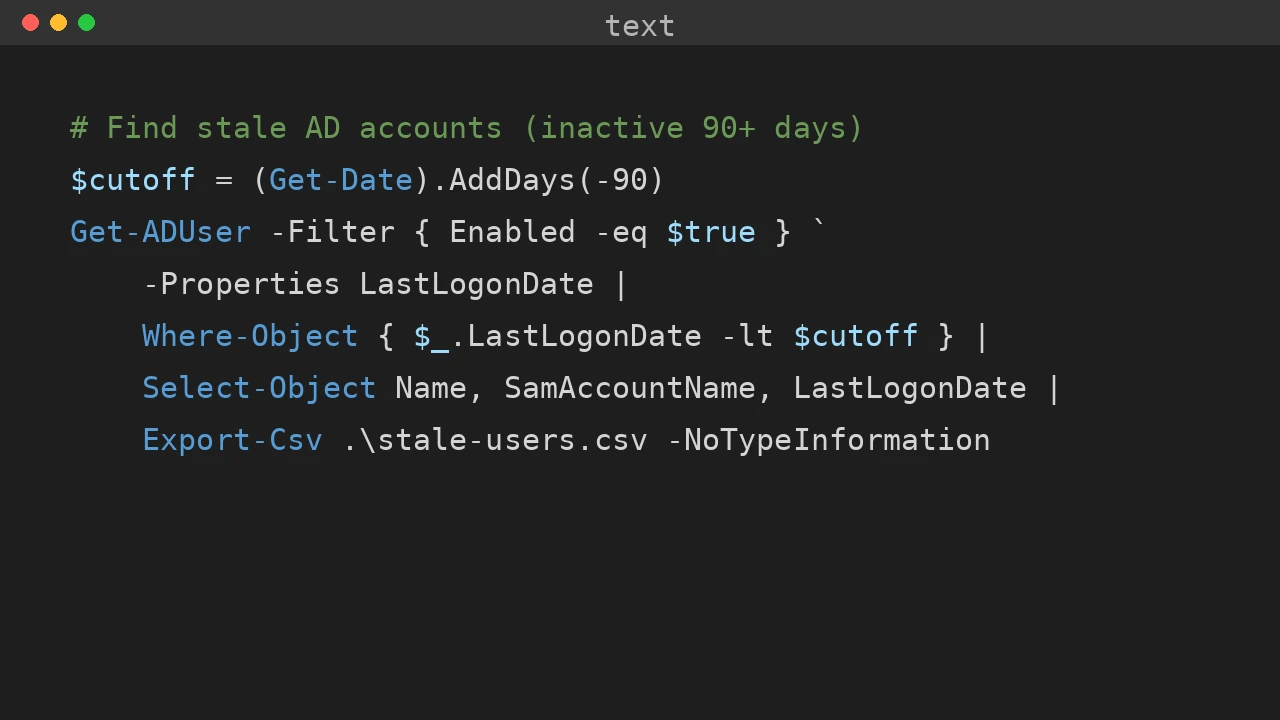
Office deployment and Active Directory maintenance often land on the same admin desk. This post collects the PowerShell workflows I use for silent Office installs, Office activation firewall rules, Get-ADUser reporting, and domain rejoin cleanup when a Windows device has stale identity state. Quick answer Use PowerShell to make Office and Active Directory work repeatable: deploy Office with the Office Deployment Tool and a checked configuration.xml, open only the firewall rules needed for activation, export AD user data with Get-ADUser, and fix stale device identity by checking domain join, Azure AD join, and dsregcmd output before rejoining the computer. ...

December 25, 2025 · PwshTips

PowerShell for Cross-Platform Administration

Most admin work I do is not purely Windows or purely Linux. PowerShell may call Bash, Bash may call PowerShell, and old CMD commands still show up in scripts. This post covers the patterns I use to pass commands and data between those shells, then applies the same idea to USB access in WSL. Quick answer For cross-platform administration, use PowerShell when you need structured objects and use Bash or CMD when you need native platform tools. When crossing between shells, treat the boundary as a text boundary unless you deliberately serialize data as JSON. In WSL, use Windows paths carefully, pass commands with clear quoting, and confirm disk or USB device names before running commands that read or write block devices. ...

December 25, 2025 · PwshTips

PowerShell for IT Inventory: Getting All Installed Apps from Remote Windows PCs

Software inventory is one of those jobs that sounds simple until you need to do it across many Windows machines. For audits, license checks, cleanup work, or troubleshooting, I want a repeatable way to answer one question: what is installed, and where? This post uses PowerShell to build that report. The workflow is: get a target computer list from DNS, connect to each machine, read installed-app registry keys, and export the result to CSV. ...

December 25, 2025 · PwshTips

Manage Pinned Taskbar Items with PowerShell

Standardizing the Windows taskbar sounds like a small desktop task, but it gets awkward fast when you need to automate it. Windows does not provide a clean built-in command for managing pinned items, partly to stop applications from pinning themselves without user consent. The methods below are the ones I use when I need to inspect or clean up pinned taskbar items with PowerShell. Quick answer Windows stores user-pinned taskbar shortcuts under the user’s profile, but it does not provide a clean supported cmdlet for fully managing pins. With PowerShell, you can list pinned .lnk files from the TaskBar folder and remove unwanted shortcuts. After changes, restart Explorer for the taskbar to refresh. Test this per Windows version because taskbar behavior changes across releases. ...

October 28, 2025 · PwshTips